PRP is not a routine add-on to every child’s root canal. It is a blood-derived scaffold considered mainly for selected immature permanent teeth, so families need to identify the tooth, its stage of root development, and the treatment goal before agreeing to a blood draw or regenerative procedure. By the end, you will know what PRP involves, when it may be considered, how it compares with other options, and which questions to ask a root canal dentist in Pune.
Key takeaways
- PRP uses your child’s own blood; it requires an additional venous blood draw.
- Immature permanent teeth may benefit from regenerative treatment more than baby teeth.
- PRP supports healing but cannot guarantee root development or tooth survival.
- Ask which alternative fits your child’s tooth, age, infection, and overall health.
What PRP means in a child’s dental treatment
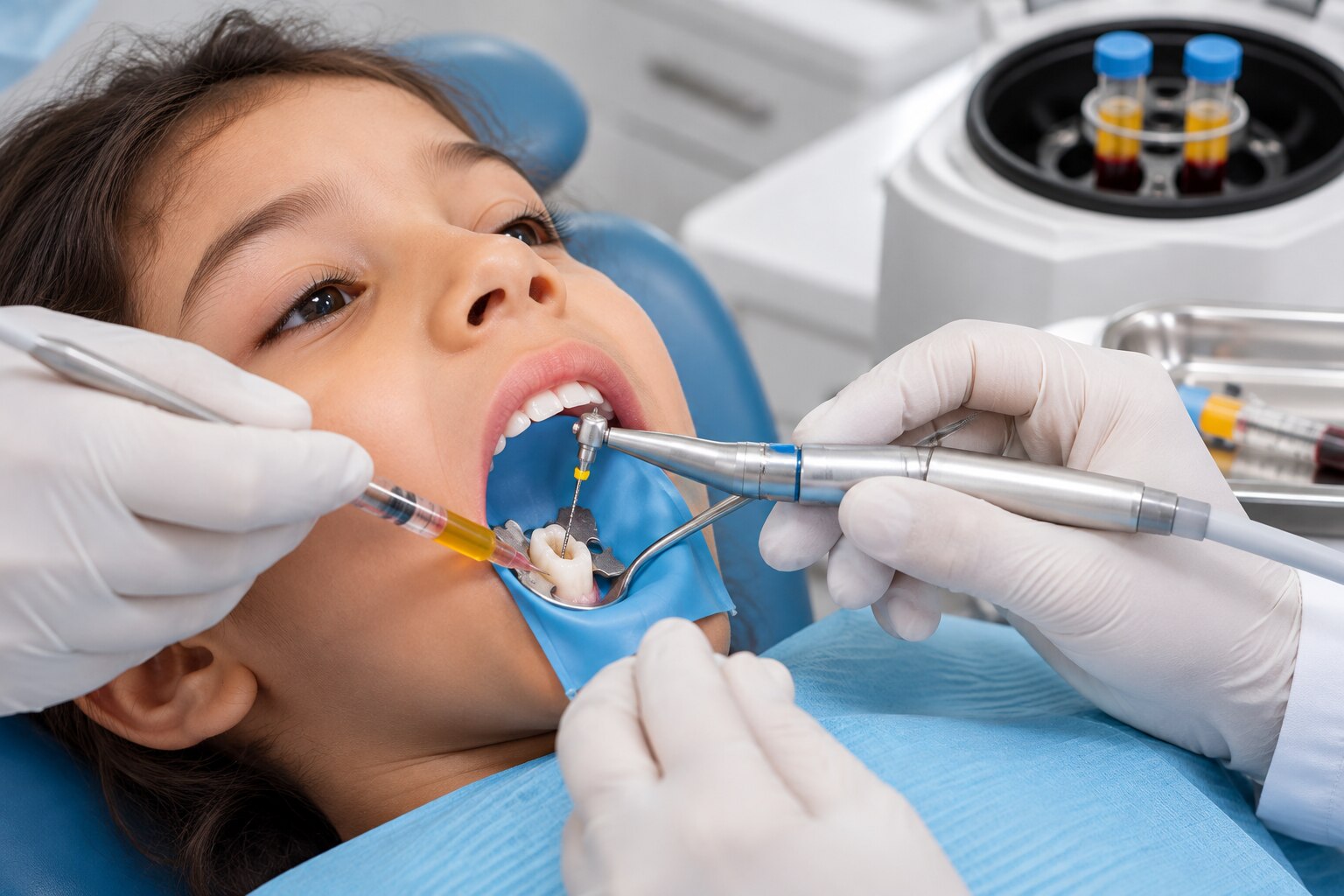
PRP means platelet-rich plasma, a concentrated portion of your child’s own blood. A clinician draws a small venous blood sample, spins it in a centrifuge, and separates plasma containing concentrated platelets and fibrin. The resulting material is not donated blood. It requires an additional blood draw during the dental visit.
In pediatric treatment, the terms describe different procedures:
- Pulpotomy removes infected or inflamed pulp from the crown of a tooth while leaving healthy pulp in the roots.
- Pulpectomy removes pulp tissue from the canals, disinfects them, and fills them; this is the usual “baby tooth root canal” for a restorable primary tooth with necrosis or irreversible pulpitis.
- Regenerative endodontic treatment is considered mainly for a necrotic immature permanent tooth with an open apex, where continued root development is still possible.
During regenerative treatment, the dentist places PRP inside the disinfected canal as a biological scaffold, then seals the tooth. It is intended to support healing and tissue response, not to replace cleaning, disinfection, shaping, or sealing.
Therefore, PRP during root canal treatment in Pune does not automatically mean an improved ordinary root canal. For a fully developed permanent tooth, PRP root canal in Pune should prompt a precise question: is PRP an evidence-based regenerative adjunct for this tooth, or an optional addition to conventional treatment?
Ask which tooth is involved and whether its roots are immature.
Baby teeth, immature permanent teeth, and ordinary root canals are different
PRP is mainly considered for a necrotic immature permanent tooth with an open apex, where treatment aims to encourage continued root maturation and healing. It is not a routine addition to every child root canal in Pune, and the label “PRP root canal” does not make it appropriate.
| Option | What the tooth needs | Usual direction |
|---|---|---|
| Pulpotomy | A restorable baby tooth with vital pulp inflammation limited to the crown | Remove the coronal pulp and preserve the healthy radicular pulp |
| Pulpectomy | A restorable baby tooth with irreversible pulpitis or pulp necrosis | Clean and fill the canals with a resorbable material |
| Regenerative endodontic treatment, with or without PRP | A necrotic immature permanent tooth with an open apex and potential for continued development | Disinfect the canal and support tissue ingrowth, healing, and root maturation |
| Conventional root canal treatment | A permanent tooth with a fully formed root and infected or inflamed pulp | Disinfect, shape, and permanently seal the canal |
A baby tooth is not a smaller immature permanent tooth. Its roots are expected to resorb as the adult tooth develops, so pulpectomy usually fits the problem better than a regenerative procedure. A mature permanent tooth also does not need PRP to complete its root; adding it does not replace proper cleaning and sealing.
Ask which tooth is involved, whether the apex is open, and why PRP is preferable to the standard treatment. Blood collection adds needle pain, bruising, or distress, so the proposed benefit must justify that extra step for this specific tooth.
What PRP can support—and what the evidence cannot promise
PRP’s clinical purpose is to support repair in a selected immature permanent tooth with a necrotic pulp and open apex. It is placed as an adjunct during regenerative endodontic treatment, not as a replacement for disinfecting the canal or sealing the tooth.
The intended goal is continued root maturation and healing around the root, rather than simply filling a fully formed root.
Research has examined whether PRP is associated with:
- Healing of infection-related bone changes around the root
- Greater root length or thicker root walls
- Continued narrowing or closure of the open apex
These findings are encouraging but not conclusive. Studies use different PRP preparation systems, disinfection methods, scaffolds, follow-up periods, and definitions of success, so their results cannot be combined into one dependable promise.
For a mature permanent tooth, PRP during root canal treatment in Pune is not a substitute for conventional treatment. Adding PRP does not automatically improve a procedure designed to remove infected tissue, disinfect the canal, and create a durable seal.
A blood-clot scaffold remains an established regenerative option, and current evidence does not prove that PRP is universally superior to it or to other regenerative approaches. Ask whether the recommendation is based on the tooth’s open apex and prognosis, rather than on the word PRP alone.
Even when healing begins, the tooth may not develop a normal root or remain infection-free.
When PRP is unsuitable and what the alternatives involve
PRP is unsuitable when the tooth does not need regenerative treatment, the child cannot safely provide a blood sample, or the tooth cannot be restored. A mature permanent tooth usually needs cleaning, disinfection, shaping, and sealing—not PRP.
Avoid it when the child has a relevant blood disorder, takes medication affecting clotting, cannot tolerate venipuncture, or the dentist cannot control contamination.
- Choose another plan when the primary tooth is best treated by pulpectomy, or when decay has left too little sound tooth to restore.
- Reconsider regeneration when infection persists, the root anatomy is unsuitable, or follow-up visits and radiographs cannot be completed.
- Ask whether the proposed PRP preparation is an adjunct or a substitute for established treatment. A “prp root canal in pune” label does not identify the correct procedure.
| Option | What it involves | When it applies |
|---|---|---|
| Blood-clot scaffold | The dentist stimulates bleeding through the open apex and uses the clot as a natural scaffold; no blood draw | Regenerative treatment for a selected necrotic immature permanent tooth |
| PRF | The child’s blood is centrifuged into a fibrin-rich membrane or plug containing platelets | An alternative scaffold when the clinician considers it suitable; evidence is not universally superior to a blood clot |
| Conventional treatment | Pulpectomy or root-canal cleaning, disinfection, shaping, and sealing | Primary teeth or mature permanent teeth needing infection control |
| Extraction with space maintenance | Remove an unrestorable primary tooth and place a space maintainer when indicated | Early loss of a baby tooth where preserving the tooth is not feasible |
For a child root canal in pune, compare the diagnosis and fallback plan, not the advertised PRP percentage.
How the appointment and treatment decision work in Pune
The visit begins with pain, swelling, trauma, medical history, and a dental examination. Periapical radiographs show whether the tooth is primary or permanent, whether the root is immature, and whether infection or bone damage is present. The dentist then checks restorability, isolation, and your child’s ability to tolerate treatment.
| Tooth and finding | Usual decision | Follow-up focus |
|---|---|---|
| Primary tooth | Pulpotomy, pulpectomy, or extraction with space maintenance | Pain, infection, and eruption of the successor tooth |
| Mature permanent tooth | Conventional root-canal cleaning, shaping, and sealing; PRP is not a routine substitute | Symptoms, healing, and the coronal restoration |
| Necrotic immature permanent tooth | Regenerative treatment with PRP, a blood-clot scaffold, or another selected protocol | Root development, healing, discolouration, and seal integrity |
Before choosing prp during root canal treatment in pune, ask:
- Which tooth is being treated, and is its root fully formed?
- Is this conventional pulpectomy, regenerative endodontics, or an optional PRP adjunct?
- Why is PRP preferable to a blood clot, PRF, conventional treatment, or extraction?
- What preparation, isolation, irrigation, medication, and final seal will you use?
- How many visits and radiographs are expected?
- What happens if pain, swelling, or infection persists?
A consultation with Dr Aniruddha Wankhade should address these points rather than rely on a PRP label or advertised success percentage. Choose a root canal dentist in Pune who explains the fallback plan and schedules clinical and radiographic follow-up.
Related services
Root Canal Treatment (RCT) is an effective procedure to save a severely decayed or infected tooth while relieving pain and preventing the need for extraction. View service → |
Kids Dentistry Our Kids Dentistry services are designed to provide gentle, compassionate, and comprehensive dental care for infants, children, and teenagers in a... View service → |
Frequently asked questions
What does PRP mean during a child’s root canal treatment?
PRP means platelet-rich plasma, prepared from a small sample of your child’s own blood. A centrifuge separates plasma containing concentrated platelets and fibrin for use during treatment.
Is PRP suitable for baby teeth?
Baby teeth, immature permanent teeth, and fully developed permanent teeth require different treatment decisions. PRP is more closely associated with regenerative procedures for immature permanent teeth than with routine baby-tooth pulpectomy.
What can PRP support, and what can it not guarantee?
PRP can provide a biological scaffold and growth-factor-rich material during selected regenerative procedures. Evidence does not guarantee continued root development, complete healing, tooth survival, or better results than every alternative.
What alternatives exist when PRP is unsuitable?
Options can include conventional root canal treatment, regenerative endodontic treatment without PRP, extraction followed by space management for a baby tooth, or specialist referral. The choice depends on the tooth’s development, infection, restorability, and the child’s health.
How is the PRP decision made in Pune?
A root canal dentist in Pune reviews the child’s symptoms, dental radiographs, tooth maturity, infection, restorability, medical history, and ability to tolerate a blood draw before discussing benefits, limits, risks, and alternatives.
Keywords