Pain at the back of your mouth is not the only clue that a wisdom tooth needs attention. Repeated gum swelling, trapped food, bad taste, restricted jaw movement, or damage visible on an X-ray can matter even when the tooth feels normal; by the end, you will know when to book an assessment, seek same-day care, or discuss monitoring instead of removal.
Key takeaways
- Recurring pain, swelling, bad taste, or limited opening needs a dental assessment.
- Fever, facial swelling, trouble swallowing, or breathing needs same-day care.
- A painless impacted tooth can damage the second molar beside it.
- Removal depends on examination, X-rays, symptoms, damage, and future cleaning access.
Which warning signs mean your wisdom teeth need an assessment?
Recurring or worsening symptoms justify a dental assessment; one or two days of mild soreness while a tooth breaks through usually does not.
These dental signs help determine whether wisdom teeth need removal in Pune, but extraction is not automatic: decay in the second molar, gum disease, a cracked tooth, jaw-joint pain, and non-dental problems can feel similar.
- Book a routine appointment for repeated pain at the back of the jaw, a swollen gum flap, food trapping, painful chewing, cheek biting, persistent bad breath, foul taste, discharge, or reduced mouth opening.
- Arrange prompt care when symptoms keep returning, last beyond the brief eruption period, or become more intense. A partly erupted tooth can develop pericoronitis beneath the gum flap, trap plaque, or damage the neighbouring molar before severe pain appears.
- Seek same-day dental or medical care for spreading facial swelling, fever, difficulty swallowing or breathing, swelling near the eye or neck, or an inability to open your mouth normally.
| Symptom pattern | What it suggests | What to do |
|---|---|---|
| Brief, mild soreness during eruption | Temporary gum irritation without clear disease | Monitor and arrange care if it persists |
| Repeated pain, swelling, or food trapping | Pericoronitis, decay, or an uncleanable tooth | Book a dental examination and imaging |
| Painless but partly erupted or impacted tooth | Possible decay, gum pockets, root damage, or a cyst | Arrange an assessment rather than waiting for pain |
| Clear swelling with fever or swallowing difficulty | Infection that may be spreading | Seek same-day care alcove |
When do wisdom tooth symptoms require same-day care?
Swelling that spreads, fever, difficulty swallowing or breathing, or a severely restricted jaw opening requires same-day dental or medical care; brief, improving eruption soreness can wait for a routine appointment.
| Situation | Signs | Action |
|---|---|---|
| Routine appointment | Short-lived soreness, mild gum tenderness, occasional food trapping, cheek biting, foul taste, bad breath, or pain that settles | Book an examination, especially if symptoms recur or worsen |
| Same-day dental care | Increasing gum or facial swelling, pus, painful chewing, fever, or difficulty opening your mouth normally | Contact an urgent dentist today |
| Emergency medical care | Swelling spreading toward the eye or neck, difficulty breathing or swallowing, or inability to open your mouth | Seek emergency medical help immediately |
For wisdom tooth problems in pune, do not wait for a routine slot if swelling is expanding or you feel unwell. A spreading infection can threaten deeper facial spaces and the airway.
Antibiotics can be appropriate when infection causes spreading swelling, systemic illness, or restricted mouth opening. They do not remove an impacted tooth, diseased gum, or trapped debris, so treatment such as cleaning, drainage, or extraction is still needed.
Pain relief can hide progression. If symptoms return after temporary improvement, arrange dental assessment rather than repeatedly treating the ache at home.
How can a painless or partly erupted tooth damage nearby teeth?
A wisdom tooth does not need to hurt before it harms the second molar. A partly erupted tooth leaves a gum flap over part of its crown, creating a sheltered space where plaque and food remain after brushing.
1. Food trapped beneath the gum flap can trigger pericoronitis, localized gum inflammation around the wisdom tooth. Repeated inflammation can form a periodontal pocket beside the second molar, allowing bacteria to reach deeper supporting tissues.
2. A tilted or crowded tooth can press against the second molar and create a narrow, difficult-to-clean contact. Decay may then develop on either tooth, even when the wisdom tooth looks small or feels normal.
3. An impacted tooth can touch the second molar’s roots. That contact can contribute to root resorption, where part of the neighboring root is gradually lost; a dental examination and radiograph are needed to detect it.
4. A cyst around an impacted wisdom tooth can enlarge silently inside the jaw. As it grows, it can remove bone, displace nearby teeth, or affect the second molar before swelling or pain appears.
Persistent food trapping, bleeding beside the second molar, a foul taste, or a back tooth that cannot be cleaned deserves assessment. Do not judge the risk from the visible gum alone: the damaging part may lie below it.
What does a dentist check before recommending wisdom tooth removal?
Extraction is not the automatic answer to every ache behind the last molar. A wisdom teeth dentist first confirms which tooth is responsible, whether disease is present, and whether removal’s risks outweigh monitoring or another treatment.
1. The clinical examination checks the gum flap, swelling, pus, food trapping, jaw opening, chewing tenderness, cheek biting, and the second molar beside the wisdom tooth. The dentist also looks for decay, gum pockets, a crack, loose teeth, and signs of jaw-joint pain.
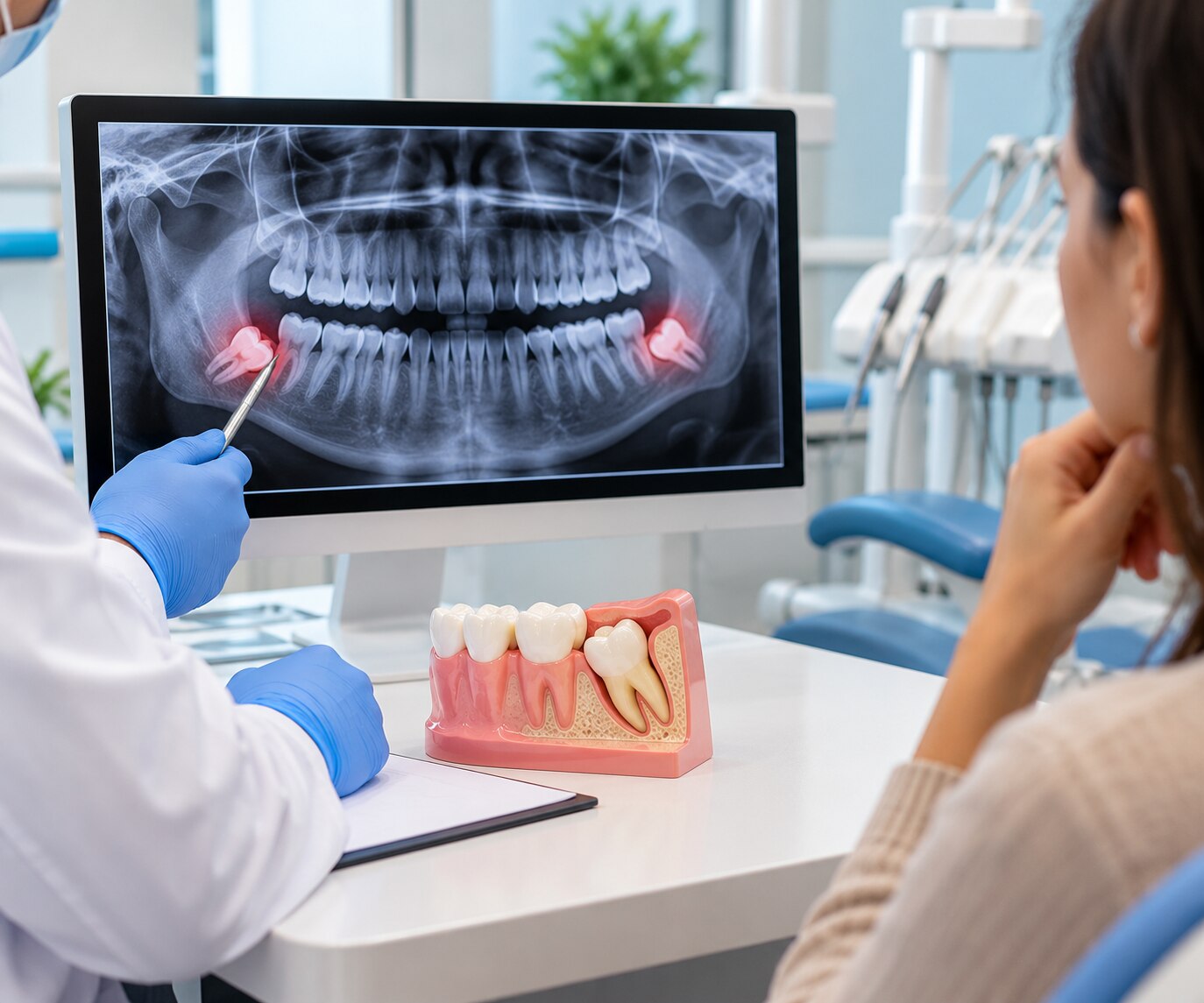
2. A panoramic radiograph shows the wisdom tooth’s angle, roots, surrounding bone, neighbouring tooth, and relationship to the inferior dental canal. It can reveal root resorption, hidden decay, cyst-like spaces, or displacement that a visible gum cannot show.
3. A CBCT scan is selective, not automatic. Requesting three-dimensional imaging makes sense when the panoramic image suggests close root contact with the nerve canal or when that detail could change the surgical plan. At an assessment with Dr Aniruddha Wankhade, ask what specific finding makes CBCT useful.
4. For a lower tooth near the nerve, the clinician discusses altered sensation affecting the lower lip, chin, or tongue. Anatomy and surgical difficulty determine the risk; a high-risk case may prompt discussion of coronectomy rather than complete removal.
The dentist must also separate wisdom-tooth disease from decay in the second molar, gum disease, a cracked tooth, jaw-joint pain, or non-dental causes. Persistent swelling, numbness, unusual imaging, or tooth displacement requires prompt assessment because a cyst or other lesion may need treatment beyond extraction.
Related service
Wisdom Teeth Removal: Safe, Painless Tooth Extraction Care Wisdom Teeth Removal: Safe, Painless Tooth Extraction Care Wisdom teeth can cause pain, swelling, infection, crowding, and damage to nearby teeth if they do not erupt properly. View service → |
When is removal better than monitoring or saving the tooth?
Removal becomes more sensible than monitoring when the wisdom tooth repeatedly causes disease, cannot be cleaned or repaired reliably, or threatens the second molar. Dental wisdom tooth removal is not based on discomfort alone; the pattern, tooth position, restorability, and radiographic findings matter.
Extraction becomes more likely when you have:
- Recurrent pericoronitis, with repeated pain, swelling, redness, bad taste, or pus beneath a gum flap
- Decay that sits too far back, below a gum edge, or in a position you cannot clean, making a predictable filling unlikely
- Decay, gum-pocket damage, root resorption, or pressure-related damage affecting the neighbouring second molar
- An infection that returns or spreads despite cleaning and treatment
- A cyst or other lesion around the tooth, identified during examination or on a panoramic radiograph
A first mild episode of pericoronitis does not automatically require tooth extraction for wisdom teeth. Repeated or severe episodes change the balance because each flare can damage the gum and complicate later treatment.
Monitoring can be reasonable when the tooth is fully erupted, painless, functional, free of significant decay or gum disease, and easy for you and a hygienist to clean. A dentist can review it during routine examinations and repeat imaging when findings or symptoms change.
Saving it is a poor choice if its position leaves trapped plaque, an unrepairable cavity, or ongoing injury to the second molar.
Frequently asked questions
Which warning signs mean your wisdom teeth need an assessment?
Arrange an assessment for recurring or worsening pain, swollen gums, bad taste, pus, food trapping, difficulty opening your mouth, or cheek swelling. Mild soreness for one or two days while a tooth erupts usually does not require urgent care.
When do wisdom tooth symptoms require same-day care?
Seek same-day dental or medical care for facial swelling, fever, rapidly worsening pain, difficulty swallowing, difficulty breathing, or an inability to open your mouth normally.
How can a painless or partly erupted tooth damage nearby teeth?
An impacted or partly erupted wisdom tooth can trap plaque and food against the second molar, causing decay, gum infection, bone loss, or root damage without early pain.
What does a dentist check before recommending wisdom tooth removal?
The dentist checks symptoms, gum inflammation, tooth position, eruption space, decay, damage to the second molar, mouth opening, and X-rays showing roots, bone, nerves, and nearby structures.
When is removal better than monitoring or saving the tooth?
Removal is more suitable when the tooth causes repeated infection, decay, cyst-related changes, damage to the second molar, or cannot be cleaned and restored reliably. Monitoring can suit a healthy, functional tooth that remains disease-free and easy to examine.
Keywords